I've been pondering, but not actually doing anything with laser-based object detection for a year now, for both the Trinity-style firefighting competition and the Sparkfun AVC.
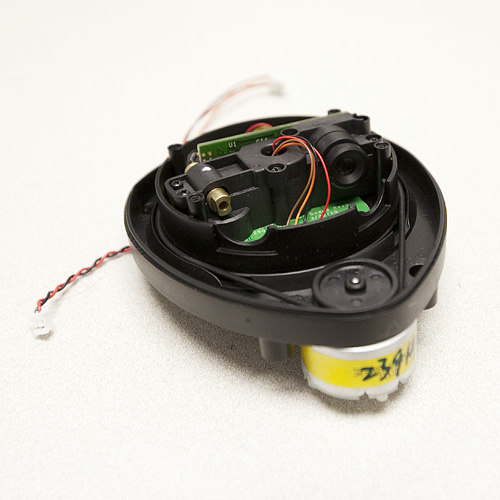
The XV-11 unit looks to me like a camera and a laser pointer spun by a small CD motor (details of the system in this white paper). Picture from Sparkfun below. How hard would it be to hack something like this together?
Awhile ago I bought a line-generating laser to identify obstacles. Powered with a LM317 generating the required 3.0V, the laser generates a pretty nice line once you focus it.


Based on ideas I found online, one places the laser at some point low on a robot, with the laser's axis and line parallel to the ground, while the camera is placed some distance above and pointed slightly down, so that parallax can be leveraged.
A horizontal line is generated lower in the camera image for nearby objects, and higher in the image for far away objects.
Since I'm using Pokey's grayscale camera, rather than a color camera, I took pictures with and without a photographic red filter to see if that would help distinguish the laser reflection.
 |
| Laser line, red filter. Note height of line on cup, laser printer. |
 |
| Laser line, no red filter |
One could probably write code to detect the line even in a grayscale image although this would be substantially easier with an IR laser and IR filter. Or with a color camera.
Here's a color picture of the test area, my desk. Old HP laser printer to the left, McD's cup, front and center, etc.

As for the LIDAR concept, put a camera next to a laser pointer, align them to leverage horizontal parallax so one can measure distance based on the position of the dot.
I was curious to see what a tiny red laser pointer dot would look like on the grayscale camera. The dot is pretty tiny at about 8' distance (see red arrows).
 |
| Distant dot (red arrow), no red filter |
 |
| Distant dot, with red filter |
Maybe too tiny to reliably detect, although with the LIDAR one can constrain the search area vertically and possibly horizontally.
And constrain the search algorithm to square and circular shapes.
Come to think of it the code could correlate dot size with position for added robustness.
And actually the red filter seems to make the laser dot the brightest thing in the image, once the exposure and gain is set properly.
 |
| Nearby dot, no red filter |
 |
| Nearby dot with red filter |
Doing a 360 degree sweep at 10Hz like the XV-11 means 3600fps which suggests it is using a much faster optical device than Pokey's camera or anything like it. I am guessing Neato is using a linescan sensor. You also need a fast processor. Speculation on the Sparkfun teardown blog post points to a Texas Instruments DSP device, TMS320C2801 at the heart of the XV-11 LIDAR's image processing.
I hit a wall at 3fps with an Arduino running Pokey's camera. I'm in the middle of interfacing with a Propeller but at absolute best I can get from that camera is 30fps. Nowhere close to fast enough for LIDAR. But workable with the laser line sensor concept. But all that's best left to another blog post or two.
I plan to just wait for someone to hack the XV-11 LIDAR and wait for spare parts to come out of Neato and hope I can afford the darn thing or build it myself for $30 as promised.


